

The Death of the Default Internet
Trend Report 01/2026


For the last decade, we lived in the age of the Default Internet: one feed to rule them all, where your high school friends, breaking news, unhinged political takes, and influencers selling gut-health powder all coexisted in more or less the same chaotic stream. That era seems effectively dead.
We are seeing a bifurcation of digital culture, not dissimilar to global politics, torn into extremes. The center has collapsed. You are either watching cinematographic masterclasses on YouTube by Gen Alpha showrunners or 144p human slop improv comedy captured on Ray-Ban glasses. You are either life-maxxing with a brick phone or biohacking your way through an extreme wellness retreat.
We’re entering 2026 by being forced to reckon with this paradigm shift: the way we consume, connect, date, and dissociate, will fundamentally change.
From our vantage point, here’s what we see for the iNte~NEt in 2026, what it means for most brands, plus the KPIs to measure your success (if you dare to even try winning this game).
1. The Trust Collapse: Scrutiny First
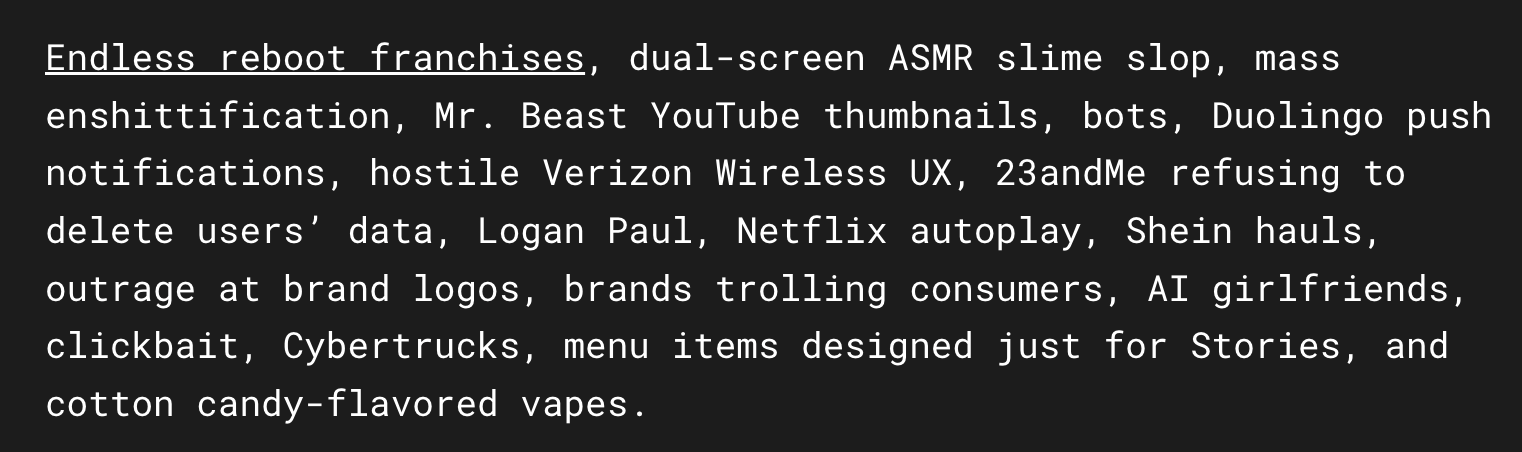
GenAI content barged in like a wrecking ball on social feeds in 2025: “AI slop”, “digital twins”, influencers outsourcing themselves to clones, but also embarrassing attempts at GenAI brand campaigns (Coca Cola, Balenciaga, Equinox). This led to the inevitable collapse of trust and the growing fear of, “Is this AI?” Surprise! People hate feeling tricked.
And this isn’t just about commerce, sales and advertisment. When even The New York Times struggles to verify images of captured Nicolás Maduro, and governments normalize releasing AI-generated imagery, what can we expect?
Gen Z and Alpha are exercising this membrane of doubt by amping up on the scrutiny: over half of Gen Z now checks comment sections before buying, prioritizing peer validation over official brand channels. This skepticism is measurable: luxury brand content on TikTok saw comments surge 113% year-over-year as users sought authentic takes from real people.
peopleperson 🌶️ take: Chasing algorithms and attention-grabbing content short-cuts (especially through AI) won’t cut it anymore. The brands that succeed will have to earn trust through transparency: engaging with their audiences through comments & DMs, revealing their behind the scenes, valuing craftsmanship, and proving they’re not taking cheap shortcuts to reach their audience.
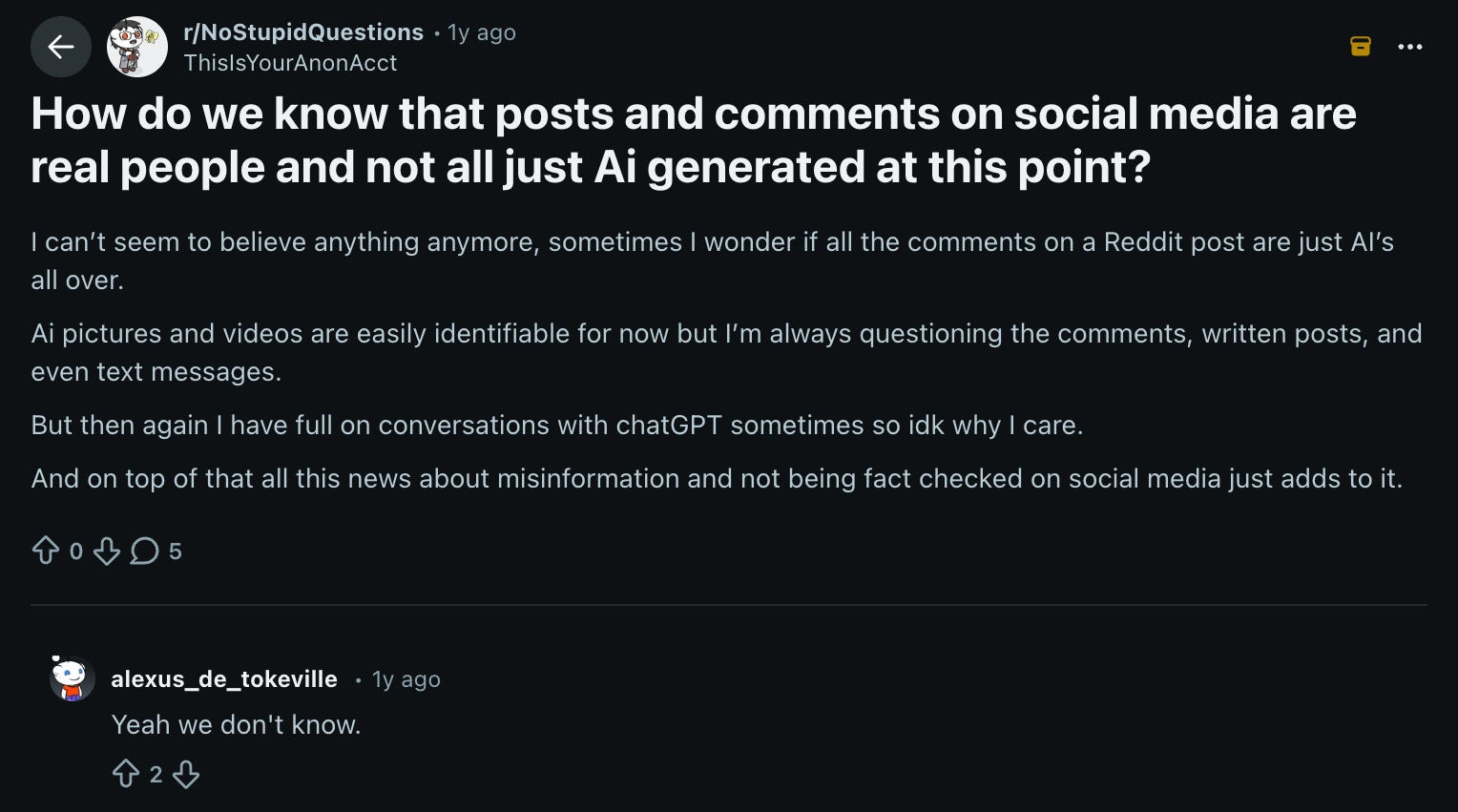
KPI: People screenshot and share your comments section more than your actual post
2. Content: Oscars or Surveillance Footage
The middle ground of visual content is over for brands and creators. We are seeing Nassim Nicholas Taleb’s Barbell Effect in action: the polarization between the low-cost/high-volume (budget) and high-quality/luxury (premium) extremes.
On one end, you have creators acting like A24 directors, producing high-value, cinematographic masterclasses that rival Netflix. Instagram’s 2025 Rings Awards validated this trend: more than half the winners use professional cameras and deliver polished, high-production content (or, like winner Adrian Per, teach creators how to film cinematically on socials).
On the other end, you’ll find “anti-AI”, potato-quality, reality-TV-like streaming content. Raw, rough, feels like surveillance footage, and is, until further notice, unmistakably human. Sometimes even purely accidental. Livestreaming still dominates, especially amongst the young: livestream platforms pulled in nearly 30 billion hours of watch time in Q2 2025 alone, with over 40% of Twitch users aged 16-24. There’s a streamer for everything. Netflix is, ironically, trying to become more like YouTube.
Why is this polarization happening? Social platform leaders urge creators to counterfight the content slop-ification by delivering “imperfect,” “rough”, “raw” content. “Imperfection becomes a signal,” notes a lengthy Threads essay from Adam Mosseri, Head of Instagram.
peopleperson 🌶️ take: Aesthetics are a red herring. The widespread disgruntlement with GenAI content isn’t about preferring one visual style over another, it’s about audiences craving substance, craft, meaning. Mosseri’s advice about ‘rough aesthetics’ misses the point entirely: AI can replicate rough visuals just as easily as polished ones. What matters is having something to say. Create content with a genuine point of view that resonates with your audience, regardless of style. People don’t spend hours watching streamers because they love lo-fi visuals, they do it because the content feels relatable, real, and human.
KPI: Sean Baker notices your content and asks you to shoot his next feature
3. Lifemaxxing and Misbehaving
We’ve reached a tipping point with bio-hacking and hyper-optimization culture. The promise of control through productivity hacks and wellness protocols clashes with an unpredictable timeline: 84% of Gen Z can’t afford housing, unemployment amongst young people is at an all time high, support for basic education and the arts is being rolled back world over. In a nutshell, the essential building blocks of a stable life are increasingly out of our control: “You can do everything right, and still feel underwater,” to quote Kyla Scanlon.
So, what’s the point of optimization? This is what triggered lifemaxxing: the shift toward spontaneity, impulse, and anti-optimization, mixed with a bit of hedonistic escapism. In 2026, expect this trend to intensify. One thing we’re curious to see kick off: substances previously stigmatized being reframed through a wellness lens. The ketamine market has already grown to $3.4 billion, increasingly marketed as mental health therapy rather than recreation. Vices are also back (thank God!)
peopleperson 🌶️ take: Live a little! We’re ready for this coming year of misbehaviour and neo-hedonism. We’re looking forward to sweaty raves, one-too-many of everything, awkward in-person interactions, passionate protesting in the streets, and the IRL brand activations where you can finally touch that hyped product and realize it’s actually just... plastic. The winning brands will understand what young audiences want and will be able to conjure content that speaks to this hedonistic reality.
KPI: Your brand event gets shut down by noise complaints
4. Camouflage Culture
The coolest thing you can do in 2026 is hide. What started in 2025 will fully crystallize this year as Camouflage Culture becomes the dominant counter-movement. Camouflage Culture describes the growing refusal to be algorithmically legible: it’s encrypted group chats, paywalled newsletters, IYKYK references, niche subreddits, phone-locking pouches at events, and intentional ephemerality. In other words, it’s cultural capital that is defined by the experiences that never become content. It stands in stark opposition to Dashboard Culture, which rewards sensationalism over substance, and is optimized for virality.
Going off the grid becomes the only way to preserve genuine creative space. Camouflage allows ideas to ferment outside the algorithm’s gaze, where real-ness can exist without being immediately monetized or memed.
But we still want the benefits of the internet, even if we don’t want it to perceive us. The risk? Dashboard Culture—loud, grotesque, metric-obsessed—fills the vacuum left behind.
peopleperson 🌶️ take: In 2026, we expect this tension to intensify as more people (read, audiences, consumers) will choose invisibility over integrity-compromising spectacle. This mass withdrawal should serve as a wake-up call: brands must fundamentally rethink their relationship with audiences, abandon extractive engagement tactics and show up in more meaningful ways. Brands that continue optimizing for scale and virality will find themselves on the wrong side of the walls people are building.
KPI: You discover thriving Discord servers about your brand that you weren’t invited to
5. Bring Back Friction
After years of convenience-everything (one-click buying, infinite scroll, auto-play), people are actively seeking out friction as a form of returning to some degree of control and meaning. Gen Z, raised inside the seamless consumer funnel, is leading the rebellion: Vinyl records, film cameras, manual espresso machines, books without Kindle versions, cash-only establishments, flip phones.
Friction creates pause, and reinforces intention, the favorite concept of TikTok oracles everywhere. Brands that add strategic friction (limited drops, no online presence, membership requirements) will be rewarded with loyalty because scarcity and effort signal value in an age of easy access.
peopleperson 🌶️ take: We flew too close to the sun of convenience. The new luxury is making people work for it, not to gatekeep, but as proof you’re not optimizing them into oblivion. The winning brands will be those that respect their audience’s agency enough to slow down, limit access, and trust that effort creates attachment.
KPI: TikToker creates 5-part series on the journey to get your product.
 | A guest post by
|