

Creators Without Influence
Unpacking the difference, if there is any

We don’t usually separate content creators from influencers in our day-to-day work. It’s a constraining distinction. And usually kinda irrelevant. But right now, with AI flooding feeds and the German creator market more competitive than ever, it’s worth taking a look at how these terms are expressing what we mean when we talk about our work. Especially in regards to brands who want to move opinions or product through culture.
1. Creators are not influencers (but some of them might be)
A content creator’s job is production. Serialized, platform-native, optimized for feeds. Their influence is often a byproduct: their reach scales when output is consistent and style becomes recognizable. They may build a loyal community that follows them wherever they go (this is the critical part of becoming an influencer). Technically, anyone on social media can be a content creator in the broadest sense, but we’re going to use the term exclusively for people who self-describe, with intention, their posting habit as an occupation.
An influencer doesn’t need to produce anything to hold attention. Actors, athletes, thought leaders — their cultural weight precedes their content. Unfortunately, they tend to be more expensive, harder to brief, and often don’t know how to self-create for social platforms. They tend to have photographers or videographers or producers or managers who do that work for them.
Yes, there is a Venn diagram with an overlap. This is it: the gold nugget, the perfect person for the job (one might say, cough cough… a peopleperson).#
Who we need depends, ultimately, on the goals of our campaigns and clients. Most clients go by a “if I see it I’ll know it” approach, which is… good enough?, honestly.
The creator-influencer is the creator who has hustled their way into genuine influence, or the influencer who understands social media, and knows how to use platforms for themselves. This is what most brands want (not necessarily need). At the intersection of influence and content is usually longterm growth, engagement, but also trust and the power of para-social relationships.
Think about footballers. They are superstars, often the faces of cars, perfumes, insurances, and so on. They have gigantic social media presence. But they aren’t usually content creators. They post content (their team posts content).
Of course, the lines are blurry. You could argue that rapper Ski Aggu is an artist who is also a content creator, and in an endless loop, feeds one career through the other. Sara Arslan made it from lip-syncing on Tiktok to celebrity status with her viral “Take Me Späti” format. Kim Gottwald started as a content creator who wanted to succeed with his own brand and ended up one of the world’s youngest and accomplished ultra-runners.
Who we need depends, ultimately, on the goals of our campaigns and clients. Most clients go by a “if I see it I’ll know it” approach, which is… good enough?, honestly. And sometimes we keep running in circles because we can’t seem to find what we’re looking for.
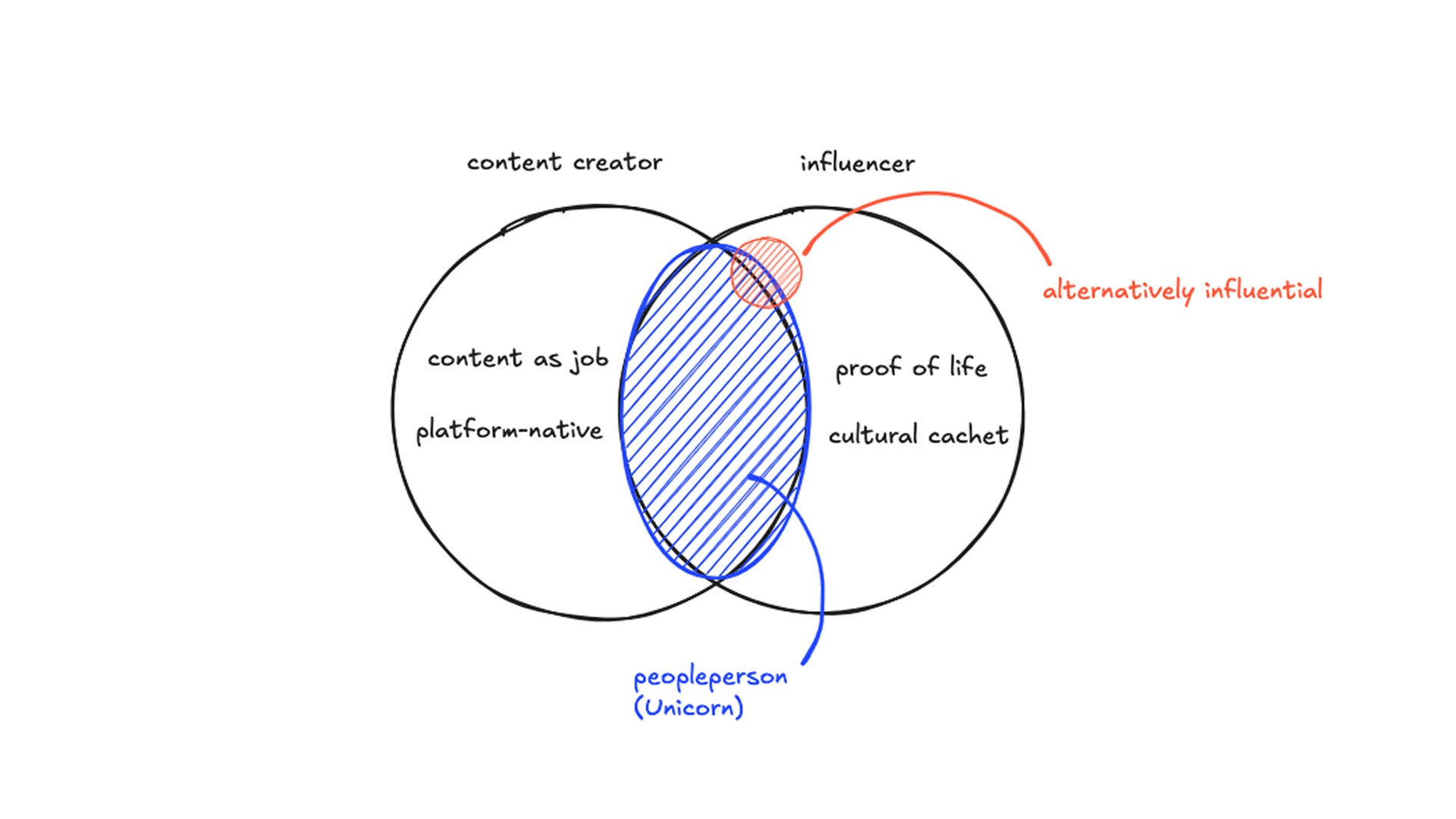
And just because we like to be on trend here, you may also consider what you’re looking for an “alternatively influential”, as proposed by the newly founded agency figures: “Talent agents are seeking out the internet’s erudite elite, promising marketers access to niche and engaged audiences far from the blast of social media”
Our industry colleagues have identified that there are people who slip through the cracks of our pro-forma definitions: artists, thought leaders and pioneers who may not create for social media but curiously seem to be everywhere you need to be, from red carpets to gallery openings and sometimes in dirty club bathrooms, from London to Barcelona.
Nothing sounds as hot as an entirely new category that doesn’t want to be close to the Instagram influencer stigma. But: this is a case in point for our article about how being offline, performative or not, is becoming a class signifier / status symbol in its own right. The luxury of the “human experience”, and so on.
2. AI vs. PEOPLEPERSON
On New Year’s Eve, Instagram CEO Adam Mosseri published a 2,000-word essay arguing that AI would make authentic creators more valuable because in a world of infinite abundance and infinite doubt, the creators who maintain trust and signal authenticity will stand out. His proposed fix: lean into raw, unpolished aesthetics as proof of humanity. According to Rachel Karten, Mosseri is betting on the momentum, not the reaction. “Rawness” is now just part of the prompt. The visual cues he’s demanding from creators are exactly the ones AI will replicate first. Mosseri himself acknowledges platforms will “get worse at identifying AI content over time as AI gets better at imitating reality.” Telling creators to look more human while your platform fills up with synthetic everything is not really a strategy.
And anyway, the real issue isn’t aesthetic. It’s abundance: Generic output, templated formats, content that could have come from anyone. The same collapse that happened to SEO writing and stock photography is arriving for creators who can’t distinguish themselves. Volume without voice or opinion.
How they will distinguish themselves is a question for another time (new camera, technologies, different platforms, other kinds of content and influence,… there are many predictions on the trend market, my bet is on “none of them”, we are not even at peak content yet. The world of true crime podcasts has showed us that this industry will grow on the nurturing ground of remixes, pastiche and dupes another decade at least).
To add more challenging layers, the AI licensing wave is already here. Companies are signing deals with creators for their likeness — face, voice, style, output — trained into models that produce content indefinitely without them. Top-line creators are beginning to sell wholesale too. Think of the Khaby Lame deal (which may or may not be a pump and dump stock scheme, but still - the idea of selling your likeness for an AI clone remains).
Genuine cultural cachet — the kind you can’t prompt-engineer — is about to get more expensive.
Ok, so is that just content, or does it influence? Does an AI Khaby Lame make you consider, believe, or - even! - purchase? Let me repose this question: if Khaby Lame stops making content, is he a believable, influential person?
I think we know the answer. Which means genuine cultural cachet — the kind you can’t prompt-engineer — is about to get more expensive. And that’s not new, but the gap between the two ends of the spectrum may get bigger and scarier.
Premium brands have always known that the right person is more important than having a crowded room. They don’t buy reach unless there’s a twist somewhere.1 They buy proximity to the right cultural nodes and let content follow.
3. Campaigns that don’t work (even yours, sorry)
The brief is usually the problem. I don’t mean the influencer brief - I mean the agency brief, the in-house brief, the brief that describes what the hell the collaboration partner is supposed to relay to their audiences, if anything. Brands like to optimize for follower count because it’s the only number that travels cleanly through a procurement process. But follower count doesn’t tell you whether someone has time, creative bandwidth, or any interest in making a native piece of content for your product.
Top-line talent is busy. That’s the point of them — they have a career that precedes the partnership. Briefing a working musician or athlete the same way you’d brief a full-time content creator is a category error. The content may be nice and all, but it will need a boost to travel. (Managements of actors and musicians already play defense before we’ve even explained our request: “Our talent is not a content creator, he won’t post in-feed, only productions, you’re not paying for their reach, etc.” They’re right, of course2. We want them for their influence and their recognizability across many audiences.)
All of this to say: the casting decision and the creative brief have to match. If you’re buying cultural legitimacy, build a partnership structure that works around a busy person’s reality. If you’re buying content performance, work with someone for whom content is the entire job. Expecting both from the same person at the same rate is how budgets disappear.
Most brands want both in one person at an entry-level price. That’s not a brief, that’s wishful thinking. You can keep chasing the unicorn, which is a competitive and expensive market, or you can run two tracks in parallel: Creators for performance, frequency, and targeted reach. Influencers for cultural legitimacy, brand halo, and trust.
4. Some data we like to look at
I don’t even know what engagement rate is anymore. Not mathematically speaking (we are women in STEM 💅🏼), just… who cares? At what point do I actually believe that there is purchasing power or real attention behind a comment or a like?3
Before we start casting, we define what we’re actually looking for. The following questions aren’t a formula, but they’re the signals we use to orient ourselves before the search begins.
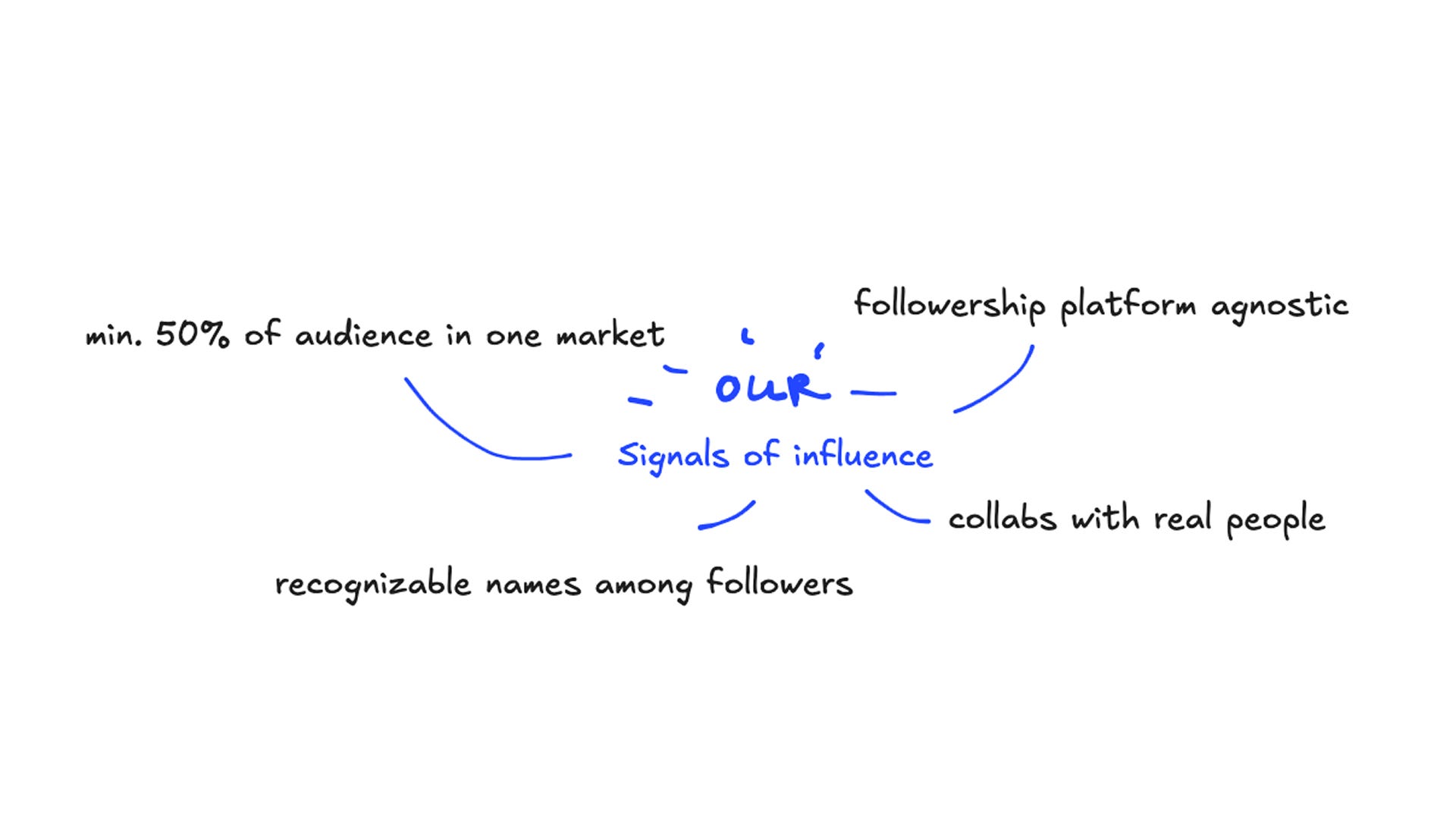
Who follows them? Do musicians, athletes, recognizable names follow this person unprompted? Do stars show up in their comments without being tagged? Do they collab with artists as peers, not as brand deals? One relevant name in their follower list says more than 50,000 anonymous ones.
Where does their audience live? Below 250k followers, geography is one of the most revealing signals in the data. Are their followers spread evenly across five countries, or concentrated in one market? Someone with 80k followers spread across five countries is a content asset. Someone with 60% of their audience in Berlin and Munich is influential in Germany.
Would their audience still show up if they stopped posting for three months? A creator’s community runs on output. Pause the output, the numbers drop. An influencer’s pull doesn’t expire between posts. If the answer is yes, you’re looking at real influence. Price and brief accordingly.
Does the content feel like the point, or the proof? For creators, content is the product. For influencers, content is evidence of a life people want access to. One is a media channel. The other is a cultural signal. Knowing which you’re buying changes everything about how you brief, what you pay, and what you measure.
Are you casting for reach or endorsement? Reach gets eyes. Endorsement gets trust — the implicit thing that makes people actually consider a product. If your campaign needs endorsement more than performance, stop optimizing for follower count.
Post-Script:
Most artists, talents, and creators would rather be caught dead than call themselves an influencer. The word has become shorthand for tasteless brand shilling — and it’s worth noting that this particular disdain is often gendered. “Influencer” is a term disproportionately applied to women, for whom it is sometimes an aspiration, not an insult.
But language carries weight, and so does what sits beneath it. This is all to say: At peopleperson, we support all women’s rights and wrongs. 💁🏼♀️
(Think about Francis, the train watching guy who was invited to collab with Gucci x The North Face. The stunt is the marketing message. Being permanently online and part of the culture is the marketing message. That doesn’t mean he has the same commercial sway Zendaya. One could cynically even say that he is the marketing equivalent of a musical one hit wonder - no other brand will achieve with him what these brands already did, and interest will naturally decline).
They’re also wrong in a predictive sense. Because more and more content creators are becoming actors, musicians, and athletes after they’ve generated audiences and community. They are grinding themselves from content to influence. People are scared of AI but I honestly think they should be scared of Gen-Z creators clawing their way out of the content slums. It takes an absolute hustler to do it consistently, with thick skin to endure all of the failure and the hate online.
Going viral isn’t just algorithmic magic — it’s a lot of manual labor (and if it weren’t, we wouldn’t have an agency). Content creators run closed group chats where they coordinate mass engagement on each other’s posts the moment they go live.